.png)
Accountability: The point where real change begins.
Updated: Sep 12

Accountability is an interesting word.
For many of us, it carries a negative meaning. We often associate it with two things:
1. Being held responsible: The shame, guilt or discomfort that can come with admitting we made a mistake.
2. Holding someone else responsible: The hurt, anger or sense of injustice we feel when someone else’s choices have affected us.
But accountability is not simply about deciding who was at fault.
True accountability is about looking honestly at a situation, recognising what belongs to us and asking:
What can I learn from this, and what can I choose to do next?
We often hear people say:
Do what is best for you.
Choose what makes you happy.
Stop worrying about what everyone else thinks.
Simple in theory. But for many women who have spent their lives putting others first, actually practising it can feel completely unnatural.
We may understand the idea logically, but when it comes time to say no, set a boundary or choose what feels right for us, everything inside us says we are doing something wrong.
It is not simply learning a new way of thinking. It is unlearning a lifetime of being taught that everyone else’s needs, feelings and expectations should come before our own.
We have spent years being taught, directly and indirectly, that being a good woman means being helpful, agreeable and available. We learn to consider how everyone else will feel before asking ourselves what we need.
We keep the peace. We carry the load. We say yes, even when something inside us is quietly saying no. Eventually, putting ourselves last becomes so normal that we stop recognising it as a choice.
This is where accountability becomes an important part of creating sustainable change.
Not because everything that happens to us is our fault. It is not. We cannot control how other people behave, the choices they make or the circumstances we sometimes find ourselves in. We are not responsible for someone else’s behaviour.
Accountability means recognising that even when we did not create the situation, we still get to decide what happens next.
That is where our power begins to return.
Why accountability can feel so uncomfortable.
The idea that our choices belong to us sounds simple, but in reality, it can feel completely unrealistic when we have spent our whole lives putting everyone else first.
Saying yes becomes so automatic that we forget we are allowed to say no.
We tell ourselves:
I have to do it.
They expect me to.
I do not want to upset them.
It is easier if I just do it myself.
I do not really have another option.
You might know you do not want to do something but immediately start thinking about who will be disappointed if you say no.
You might know a situation is draining you but feel guilty for wanting it to change.
You might finally set a boundary and then spend hours questioning whether you were selfish, difficult or unfair.
This is the part people often leave out when they tell us to simple “choose ourselves.”
Knowing you are allowed to make choices based on what feels right for you and actually feeling safe enough to do it are two very different things.
What learning accountability has looked like for me
For a long time, the idea that I could simply choose what felt right for me seemed almost crazy.
Surely I could not just say no because I did not want to do something?
What would people think?
What if they became upset?
What if they no longer wanted me around?
Learning that I was allowed to consider myself was not one big, empowering moment. It was a slow and sometimes very uncomfortable process of noticing where I was abandoning myself, understanding why and practising a different response.
Sometimes I got it right.
Sometimes I immediately backtracked.
Sometimes the guilt felt worse than simply doing the thing I did not want to do.
What I learnt is that this is exactly what unlearning looks like.
It is not easy to suddenly start making completely different choices. People will push back; try to make you feel guilty or tell you that you are being selfish. Sometimes, no one says anything at all. The guilt, fear and criticism are coming from inside us, shaped by years of conditioning rather than what is actually happening.
Changing anything takes time.
There is no perfect transition from people-pleasing to confidently holding every boundary. It happens by noticing one situation at a time, starting small and staying with the discomfort when every part of you wants to give in and return to what feels familiar.
Over time, it becomes easier.
The right people will begin to understand and respect your boundaries. More importantly, you slowly teach yourself that considering your own needs does not make you selfish. It shows that you respect yourself and expect your relationships to respect you too.
Some people may resist or even leave when you stop giving them what they have become used to receiving. That can be incredibly sad, but it also gives you valuable information.
It shows you which relationships can grow with you and which ones only worked when you were willing to abandon yourself to maintain them.
Of course, we all have responsibilities. We need to work, care for our children, meet commitments and consider how our choices affect others. Choosing ourselves does not mean doing whatever we want without considering the consequences.
Growth means recognising that within the reality of our lives, we still have choices.
Sometimes we may not like any of the options available to us. Sometimes every choice comes with discomfort, disappointment or consequences. It means we may need to choose the discomfort that protects our wellbeing instead of continuing with the familiar discomfort of abandoning ourselves.
Accountability is not blame
Accountability is not blame. Blame focuses on who caused the problem.
Accountability asks: What can I do about it now?
Someone may genuinely be behaving unfairly. They may be taking advantage of your time, ignoring your needs or repeatedly treating you in a way that does not feel right.
Their behaviour belongs to them.
What you accept, how you respond and what you choose to do next belong to you.
This can be difficult to accept because it asks us to look honestly at the ways we may be participating in situations that are hurting us. Not because we caused another person’s behaviour, but because we are beginning to recognise where we still have the power to respond differently.
Accountability also asks us to look honestly at our own behaviour. Sometimes we get things wrong.
We may hurt someone, overstep a boundary or react in a way that does not align with the person we want to be.
In those moments, accountability means acknowledging what happened, apologising when needed and making a genuine effort to do better. It is not about judging or punishing ourselves.
We are all human, and we all make mistakes. What matters is whether we are willing to learn from them, own them and do better.
The same kindness applies when we realise we stayed too long, gave too much or did not speak up sooner. Accountability should not be a reason to blame ourselves. It is about gently bringing the focus back to what we can control and asking: Now that I can see what is happening, what can I learn, and what will I choose to do next?
Resentment is your body trying to tell you something
Resentment is often treated as a negative emotion that we should ignore or feel guilty about.
But resentment is usually trying to give us valuable information.
It often appears when what we are doing no longer aligns with what we believe is right.
You may resent a colleague because you continually take on their work.
You may resent a family member because you are always the one organising, helping or making contact.
You may resent a partner because you are carrying responsibilities that should be shared.
The resentment is usually a sign that a need, value or boundary requires your attention.
Perhaps you are giving more than you genuinely want to give.
Perhaps you agreed to something that never felt right.
Perhaps you feel taken for granted or unappreciated.
Perhaps you need to communicate something you have been too afraid to say.
When we continue overriding these feelings, we create internal conflict. What we believe is right and what we continue to accept no longer match.
Accountability asks us to pause and listen to what that discomfort is trying to show us.
Not every uncomfortable feeling means another person is wrong. Sometimes we also need to examine our expectations, assumptions and behaviour.
The goal is not to find someone to blame. It is to understand what is really happening so we can choose our next step with greater clarity.
Your values help guide your choices
Accountability does not mean becoming selfish or disregarding how our choices affect other people.
It means making conscious decisions rather than living on autopilot. This is why understanding our personal values is so important.
When we know who we are and what matters to us, we have something solid to return to when guilt, pressure and other people’s expectations begin pulling us in different directions.
We can ask ourselves:
Is this aligned with the person I want to be?
Am I saying yes because I genuinely want to?
Am I agreeing because I am afraid of what will happen if I say no?
Is this relationship reciprocal?
What am I accepting that does not feel right?
What choice respects both my responsibilities and my wellbeing?
Accountability is not about always making the perfect decision. It is about making more honest ones and sharing those feelings instead of holding them inside.
Start by noticing
Accountability is a skill. Like any skill, it takes time and practice.
You may find it easier in some areas of your life than others.
You might confidently set boundaries at work but struggle with a parent.
You might communicate clearly with friends but lose yourself in a relationship.
You might know exactly what needs to change in your business but continue avoiding the decision.
This does not mean you are weak or inconsistent.
It shows you where your conditioning is strongest and where you may need more time, practice and support.
The goal is not to change every difficult relationship or situation overnight, it is learning to start small, choose one situation at a time and notice what is happening and practise one different response. Each time you follow through, you show your mind and body that change is possible.
Slowly, you begin to trust yourself and it gets easier.
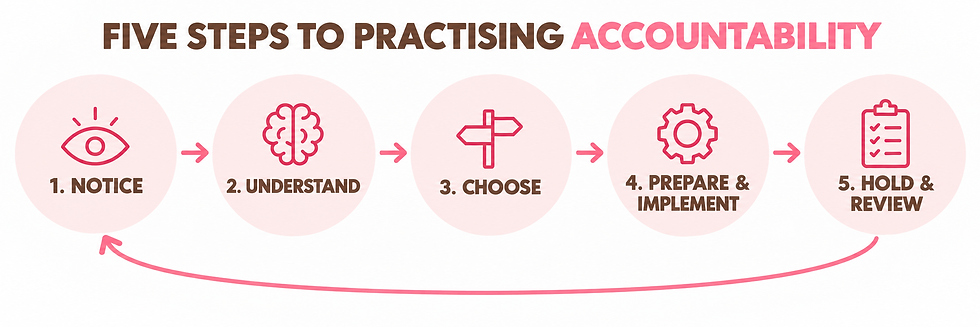
Five steps to practising accountability
1. Notice
Pay attention when something does not feel right. Resentment, irritation, anxiety, tension and exhaustion can all be signs that something needs your attention.
Instead of immediately dismissing the feeling, pause and acknowledge it: Something about this does not feel right.
You do not need to fix it immediately. The first step is simply allowing yourself to notice it.
2. Understand
Take some time to understand what the feeling is really about.
Ask yourself:
What happened?
What am I feeling?
Why is this affecting me?
What value or need is underneath my reaction?
What am I afraid might happen if I respond differently?
If you are unsure, continue asking yourself why until you move beyond the surface frustration.
You may discover that the issue is not the task itself. It may be feeling taken for granted, controlled, unappreciated or you feel like you are unable to speak honestly.
3. Choose one manageable thing to change
Think about what needs to shift and what feels possible for you right now.
Your first boundary does not need to be dramatic.
It could be declining one request, asking someone else to take responsibility, limiting how available you are or communicating what you will do differently going forward.
Choose something you can realistically follow through on.
A small boundary you hold is more powerful than a huge declaration you abandon the moment someone pushes back.
4. Prepare and implement
Expect the change to feel uncomfortable.
People may question it, particularly if they benefited from the old dynamic. You may feel guilty, anxious or tempted to explain yourself repeatedly. Remember: No is a complete sentence. Often saying less is much more helpful than over explaining. People do not need to know your reasoning to accept your choice.
Think about what you will say, how you will respond to pushback and what you will do if the boundary is ignored.
Having a plan makes it easier to stay grounded when the uncomfortable feelings arrive.
Discomfort does not mean you are doing something wrong. It just means you are doing something new.
5. Hold and review
A boundary only works when our actions support it.
You may need to repeat yourself. You may need to change how you participate in the relationship.
You may need to stop stepping in and allow another person to manage their own responsibilities.
Some people will adjust. Others may resist, negotiate or distance themselves.
Their response gives you important information.
If someone is only comfortable with you when you are over giving, staying quiet or meeting their needs at your expense, the relationship may need to change. That realisation can hurt but it doesn't mean it is wrong.
Accountability works both ways
As important as it is to notice where others overstep our boundaries, we also need to consider where we may be overstepping theirs.
Most of us can probably think of someone whose flexibility or generosity we rely on.
They are the person who always helps, rarely complains or eventually gives in if we keep asking.
We may not intentionally take advantage of them, but when someone does not clearly hold a boundary, it can become easy to continue asking more of them.
Ask yourself:
Whose time or generosity might I take for granted?
Do I respect someone’s no without demanding an explanation?
Do I make other people responsible for managing my reaction?
Do I expect someone to keep giving simply because they always have?
Accountability is not only about teaching people how to treat us.
It is also about looking honestly at how we treat them.
Bringing your power back to you
Blame can feel protective because it allows us to believe the problem exists entirely outside us, however it always leaves our future in someone else’s hands.
Accountability brings our attention back to what we can influence: our choices, boundaries, behaviour and next step.
You will not always get it right. You may recognise a pattern and still repeat it. You may set a boundary and then back away from it. You may need several attempts before responding differently begins to feel natural.
That does not mean you have failed- that is growth! Notice what happened. Understand it. Adjust and try again.
Over time, you begin to trust yourself. You become clearer about what matters, more confident in your decisions and less willing to remain in situations that continually compromise who you are.
That is where sustainable change begins. By recognising where our responsibility ends, where our choices begin and what we are prepared to do next.
Accountability is not about carrying all the blame. It is about taking your power back, one honest choice at a time.
If you are beginning to notice where you have been putting yourself last but are unsure how to change it, you do not have to figure it all out alone.
Join the Story 5 community or book a session with me and let's figure it out together; one imperfect step at a time 🩷
Like, share, follow me on socials for more tips and inspiration to get your taking back control of your life.


Comments